Night Trains: The Unseen Opportunity
Most people think night trains died because nobody wanted them. The research told a different story.
REVIVING NIGHT TRAINS AS AN AFFORDABLE TRAVEL EXPERIENCE
Group Research Project
UX Research Role | 2023
Why this topic interested me
Night trains have always felt like an underestimated opportunity to me. For people who cannot afford flights and hotels separately, a night train solves two problems at once. The journey becomes the accommodation. You board in the evening, sleep, and wake up somewhere new. No hotel booking, no early morning airport stress, no extra cost.
I suspected there was a larger audience for this than the data showed. Not because people didn't want to travel by night train, but because the experience hadn't been designed well enough to make them choose it over a budget flight.
That gap is what motivated me to join this project.
The Brief
This was a collaborative group research project exploring how night trains could be reintroduced and reimagined as a more sustainable, affordable and charming alternative to short-haul European flights.
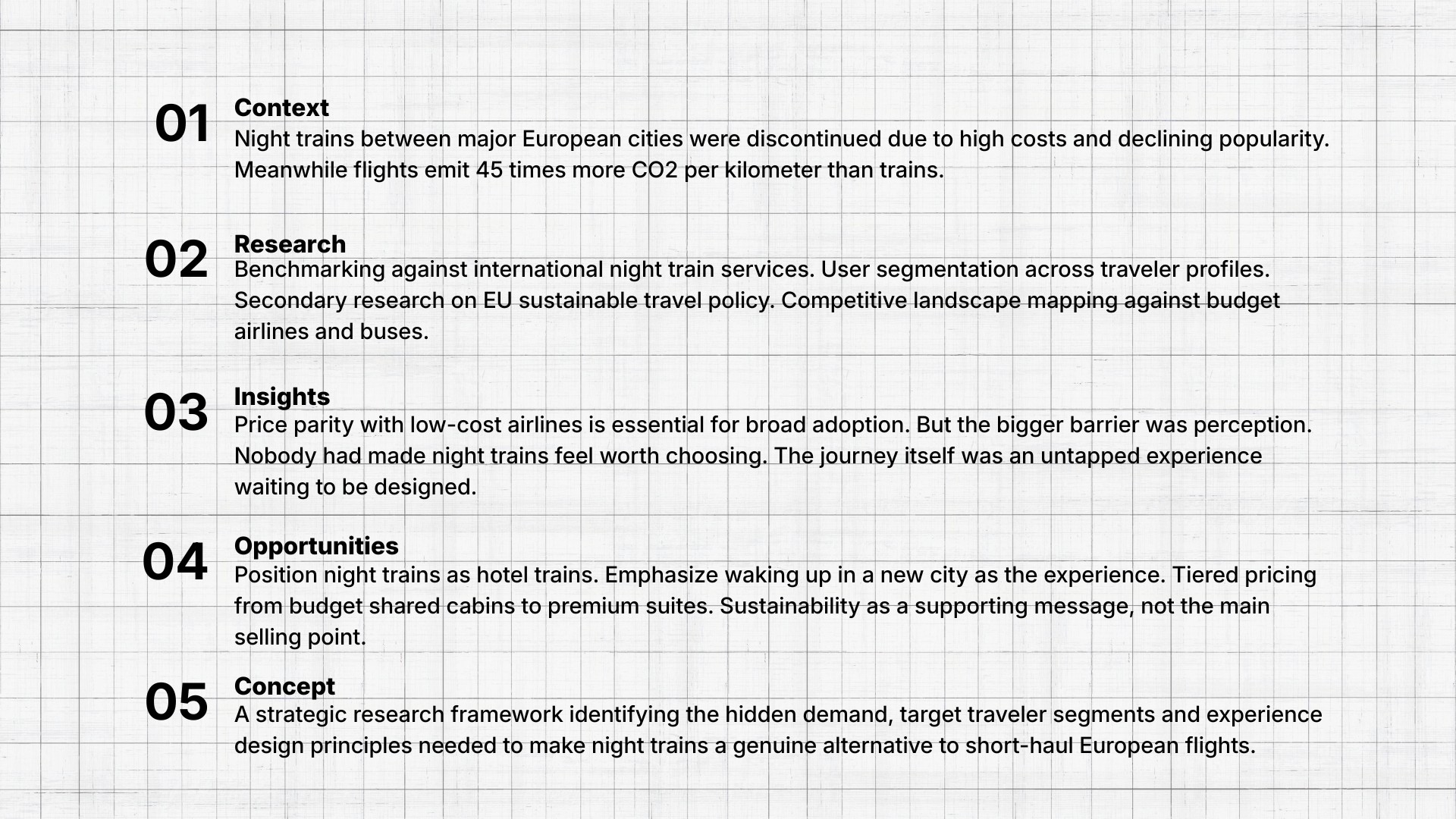
Night trains between Berlin and cities like Paris, Zurich and Amsterdam had been discontinued due to high operational costs, regulatory complexity and declining popularity. Meanwhile, one kilometer traveled by plane emits 45 times more CO2 than by train.
The opportunity was clear. The question was how to make night trains genuinely competitive again, not just environmentally, but experientially.
My specific role in this project was UX research.
What I Wanted to Find Out
I approached this as a research problem about hidden demand and unmet expectations. Four questions guided my work:
What would make night trains more appealing than flights for European travelers?
How can the night train experience balance affordability with comfort and charm?
Which traveler segments are most likely to adopt night trains and what do they expect?
How can sustainability be communicated as a benefit without sacrificing convenience?
How I Researched It
I used four research methods to build a complete picture of the opportunity.
Benchmarking analysis: I compared European night train services with successful international examples including Japan's Sunrise Express and Russia's Red Arrow. These showed what was possible when night trains were positioned as premium experiences rather than budget compromises.
User segmentation: I defined key traveler profiles based on motivations and barriers. The three most important segments were experience-seeking tourists who wanted the journey to be part of the adventure, budget-conscious travelers who needed the cost equation to work, and eco-conscious professionals who wanted to make sustainable choices without sacrificing comfort.
Secondary research: I reviewed EU sustainable travel reports, transport policy documents and traveler trend studies to understand the broader context of why night trains had declined and what conditions might support their revival.
Competitive landscape mapping: I analyzed budget airlines, long-distance buses and high-speed trains to identify where night trains could genuinely compete and where they couldn't.
What the Research Revealed
Four findings shaped the strategic direction:
Travel as an experience, not just transport. Night trains can be positioned as a mini-adventure. The journey itself, falling asleep in one city and waking up in another, is something no flight can offer. That's a genuine differentiator if it's designed well.
Affordability is non-negotiable for the core audience. Price parity with low-cost airlines is essential for broad adoption. But for certain segments, charm and comfort justify a slightly higher cost. The key is giving people a real choice between tiers.
Sustainability appeals to a growing but specific market. Eco-conscious travelers see trains as an ethical choice. But convenience and comfort must still be competitive. Sustainability alone is not enough to change behavior.
Amenities define perceived value. Private cabins, comfortable bedding, onboard dining and reliable WiFi are strong incentives especially for business travelers and comfort-focused tourists. The difference between a good and bad night train experience comes down to these details.
The Strategic Opportunity
The research pointed to one clear direction. Rebrand night trains as hotel trains. Emphasize the experience of waking up in a new city with amenities comparable to a boutique hotel. Offer tiered pricing from budget-friendly shared cabins to premium suites. Build marketing around charm, nostalgia and the romance of rail travel rather than leading with sustainability messaging.
The hidden potential I was looking for turned out to be an experiential one. People weren't avoiding night trains because they preferred flying. They were avoiding them because nobody had made night trains feel worth choosing.
My Reflection
This project taught me something important about research. The most valuable findings are often not what you expect to find. I came into this project thinking the barrier was price. The research showed the barrier was experience design and perception.
That shift, from assuming the problem to actually finding it, is what good research does. And it's the skill I most want to keep developing.
Night trains are still an underused opportunity. The demand is there. The sustainability case is there. What's missing is the design thinking to bring it all together.
