Social & Emotional Needs in Ageing
The brief asked for a product. The research changed the question entirely.

About the project
The brief asked for a product. The research changed the question entirely.
This graduation project was developed during my final year at Eskişehir Technical University in collaboration with Biyomod, a biomedical company. The brief was straightforward: develop a complete industrial design project in partnership with a company. The topic, problem space, and direction, however, were entirely open.
The project was carried out end-to-end, from defining the opportunity area and writing the brief to conducting research, developing concepts, building prototypes, and presenting the final outcome.
The topic emerged from a genuine curiosity about ageing and a feeling that many existing solutions were addressing only part of the problem. There seemed to be something more fundamental happening beneath the surface that existing products were missing.
Research
The research began in public space rather than behind a desk.
The research began in public space rather than behind a desk.
Before reviewing literature or market reports, observations were conducted in Hamamyolu, Eskişehir, to understand how older adults moved through the city, where they gathered, and how they interacted with others. The intention was to see everyday reality before reading about it.
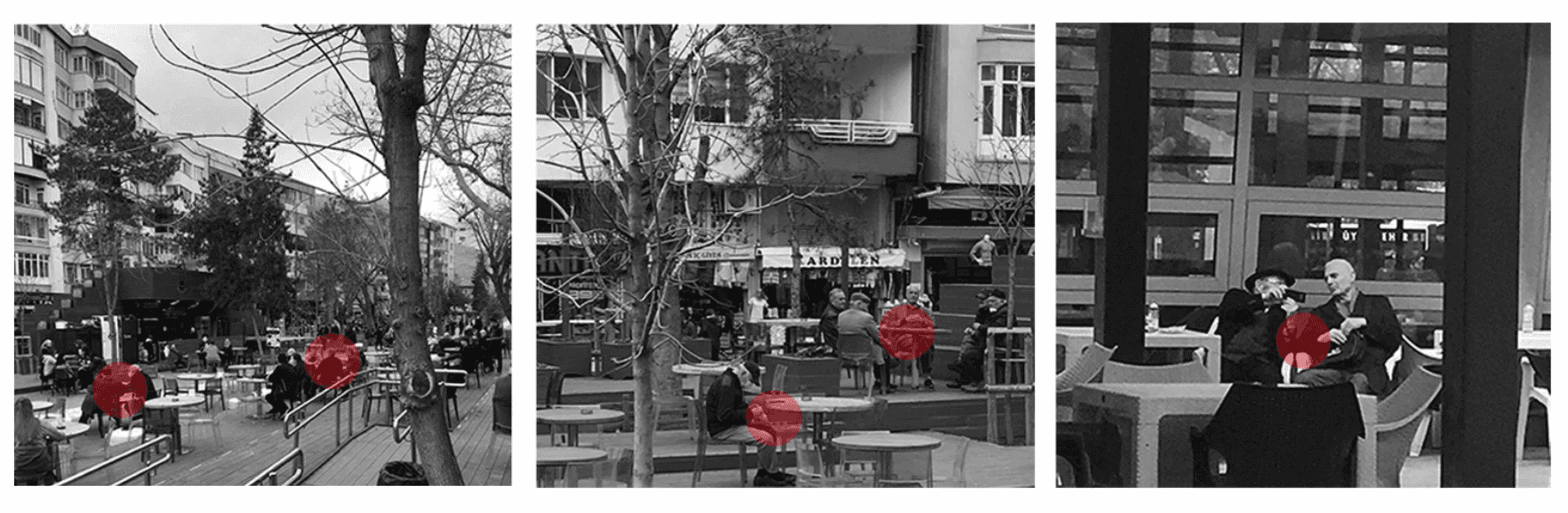
The observation phase was followed by interviews focused on daily routines, social connection, communication habits, and feelings of belonging. Additional research explored demographic trends, existing studies on ageing, and products already designed for this audience.
The numbers were significant. By 2030, one in six people globally will be over the age of sixty. In Turkey alone, more than 1.5 million elderly people were living alone in 2021. The United Nations had declared 2021-2030 the Decade of Healthy Ageing.
Yet the most important insights did not come from the statistics.
They came from the conversations.
What the Research Revealed
One participant described walking with friends less frequently since the pandemic. She talked about WhatsApp messages that felt impersonal and about occasionally remembering friends she had not spoken to for months.
Then she said:
"I get tired of always being the one to call. I'd like people to come to me sometimes."
That insight reframed the project entirely.
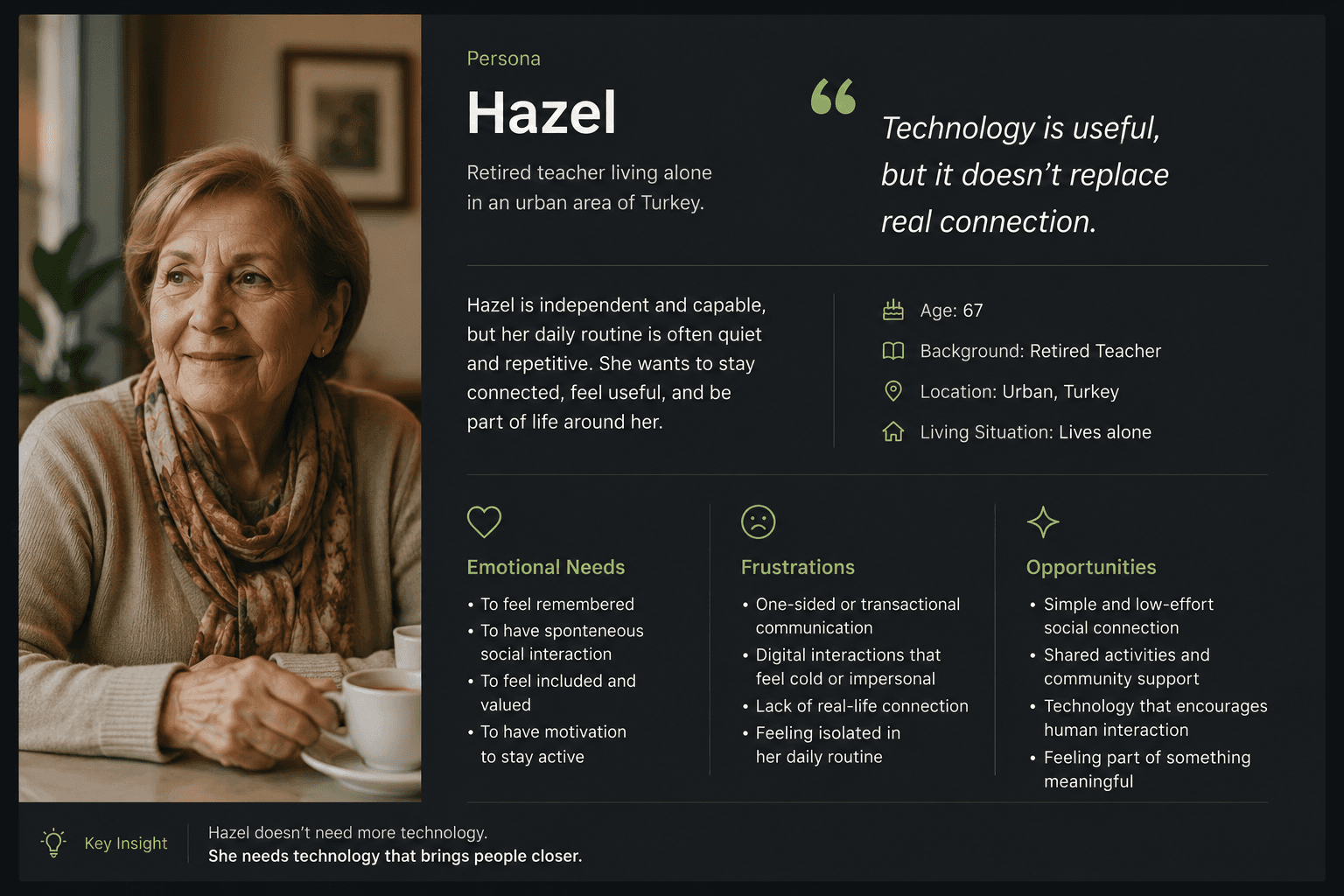
The problem was not a lack of technology. Participants already had phones, tablets, and messaging applications. What appeared repeatedly was a breakdown in the social infrastructure surrounding communication. Connection had become one-sided, effortful, and emotionally unsatisfying.
Across interviews, observations, and secondary research, four themes emerged:
Loneliness was not simply about being alone.
It was about feeling like a burden, always initiating contact, and rarely being reached out to first.Digital communication existed but felt insufficient.
Messages were functional, yet lacked the warmth and spontaneity of meaningful social interaction.Motivation to remain active was closely linked to social reasons.
People were more likely to go outside when somebody was waiting for them.Technology itself was rarely the barrier.
The challenge was how technology was designed and how it fit into existing behaviors and relationships.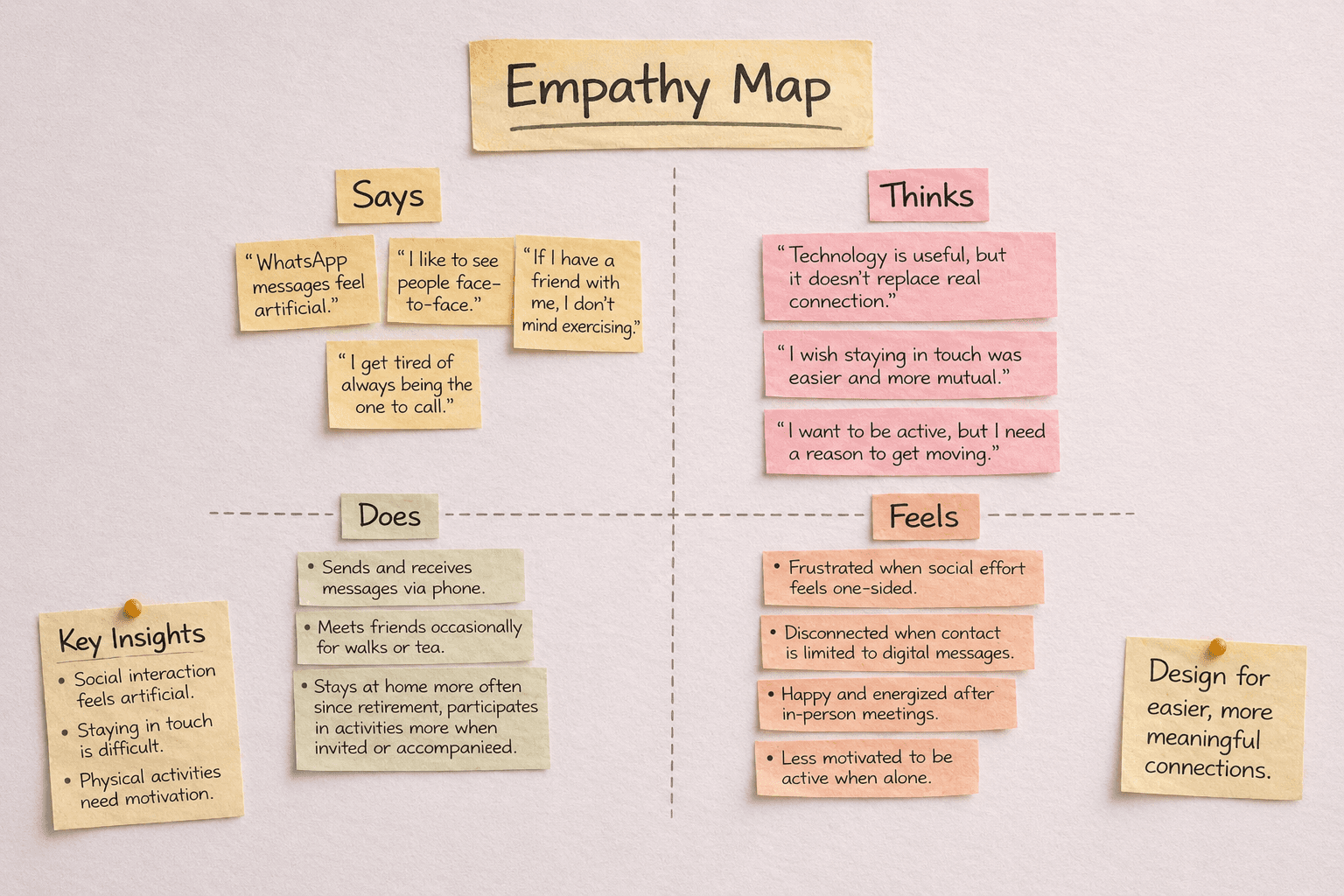
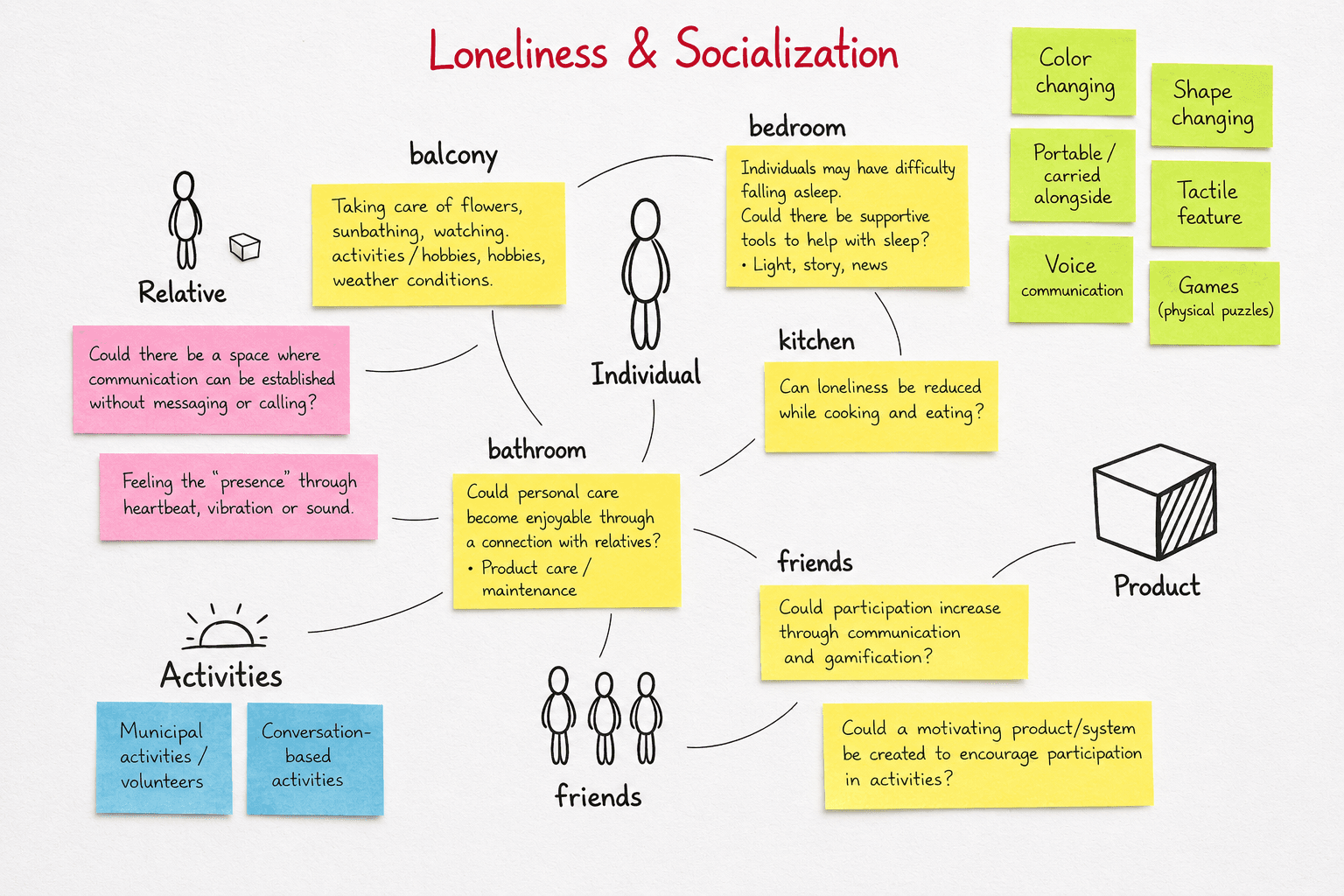
The brief required a product outcome.
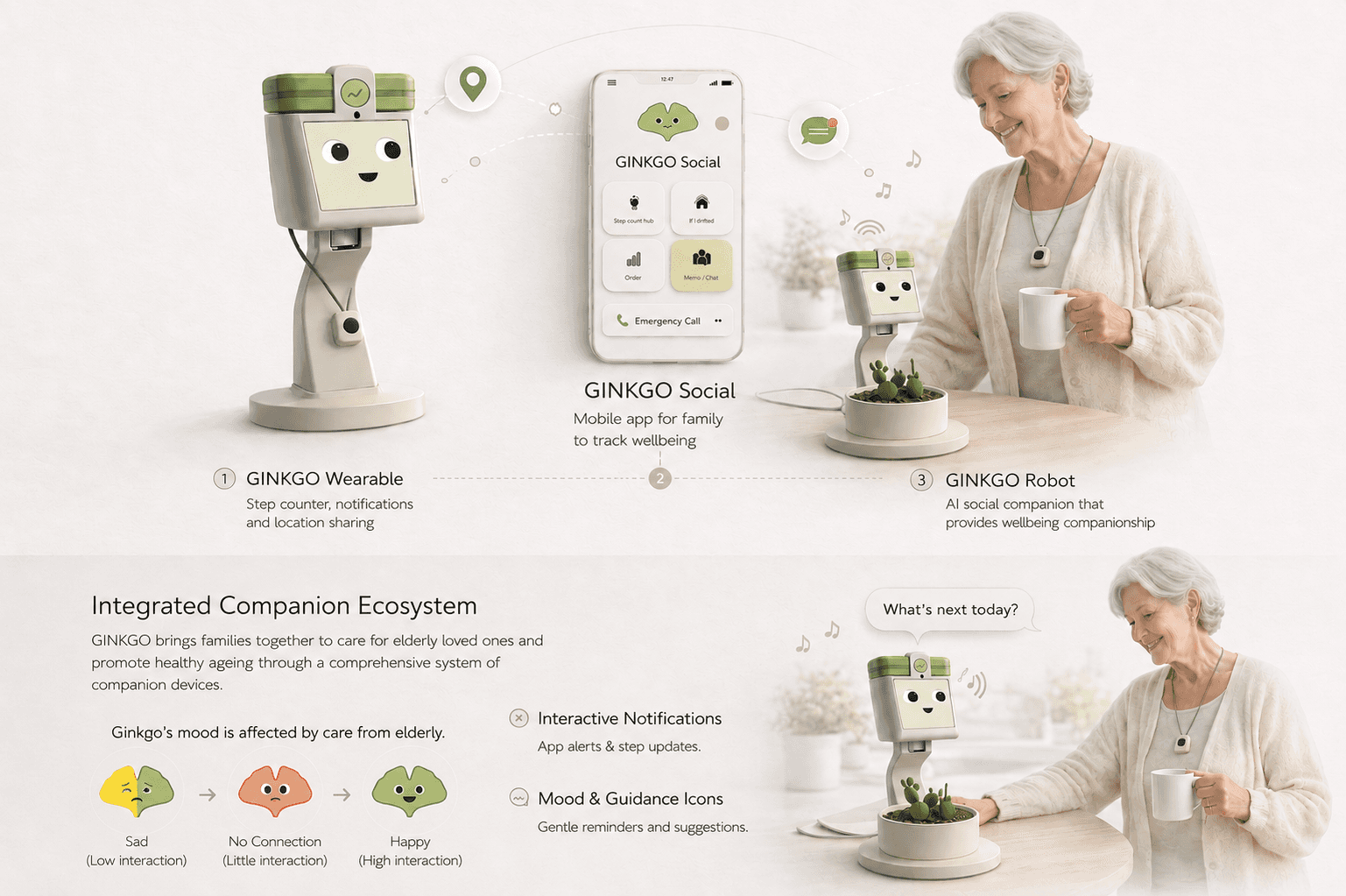
The resulting concept was Ginkgo, an AI-powered companion device designed for adults aged 65-73, supporting healthy ageing through social connection, activity, and routine.
Named after the Ginkgo Biloba tree, a symbol of longevity, resilience, and peace, the concept aimed to encourage everyday engagement rather than simply monitor behavior.
The system consisted of three connected components:
A home companion unit with an expressive face that reflected activity levels and engagement.
A portable speaker module supporting communication, reminders, and entertainment.
A wearable accessory designed to encourage outdoor activity and participation in events.
The core idea was simple.
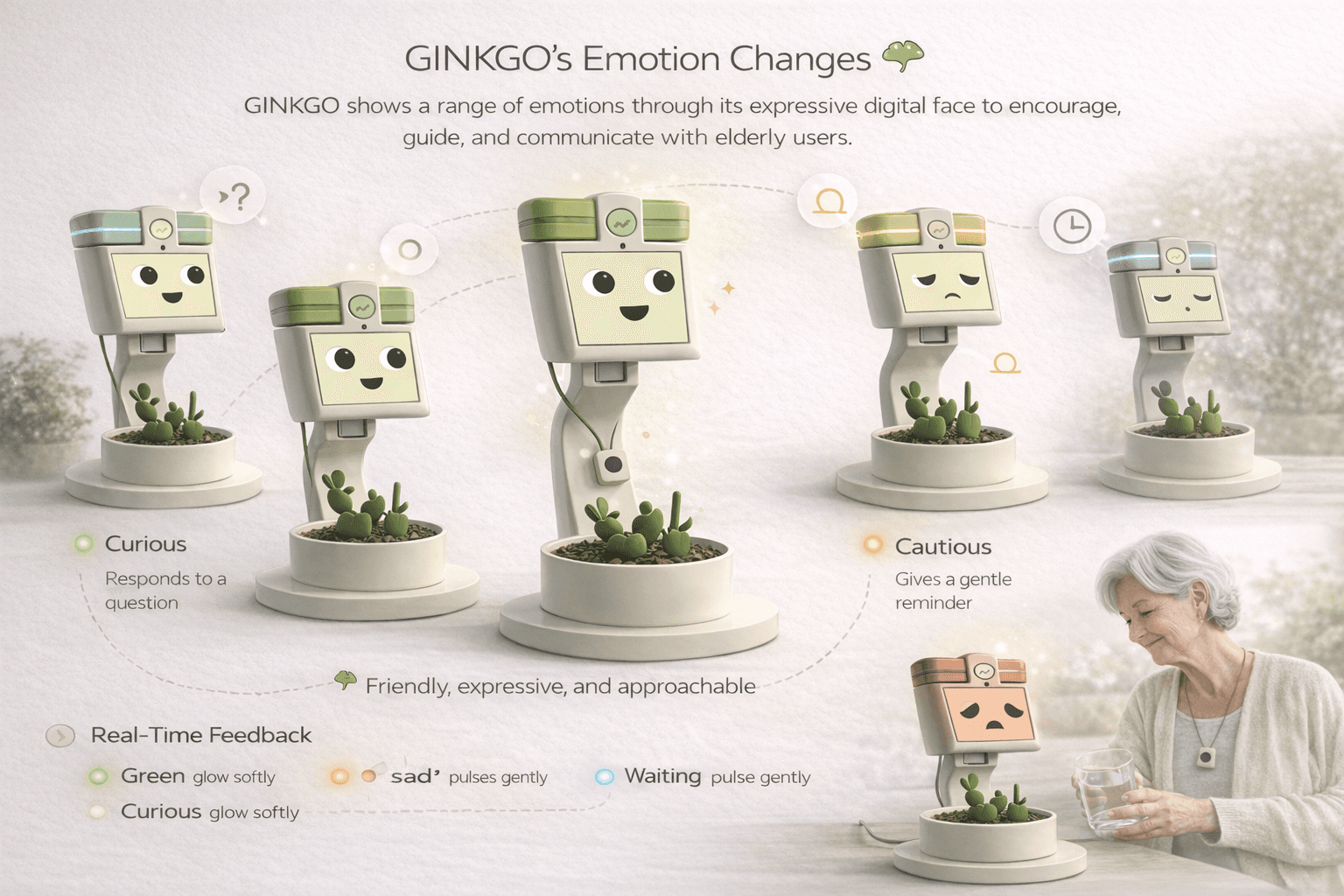
The more active and connected the user became, the more alive Ginkgo would appear. Walking, calling a friend, participating in activities, or caring for the small companion plant would trigger visible responses through color and expression. Periods of isolation and inactivity would be reflected as well.
Activity was the input. Connection was the goal.
The product acted as a bridge between the two.
Looking Back
Looking at Ginkgo today, the project feels less like a product concept and more like the beginning of a shift in perspective.
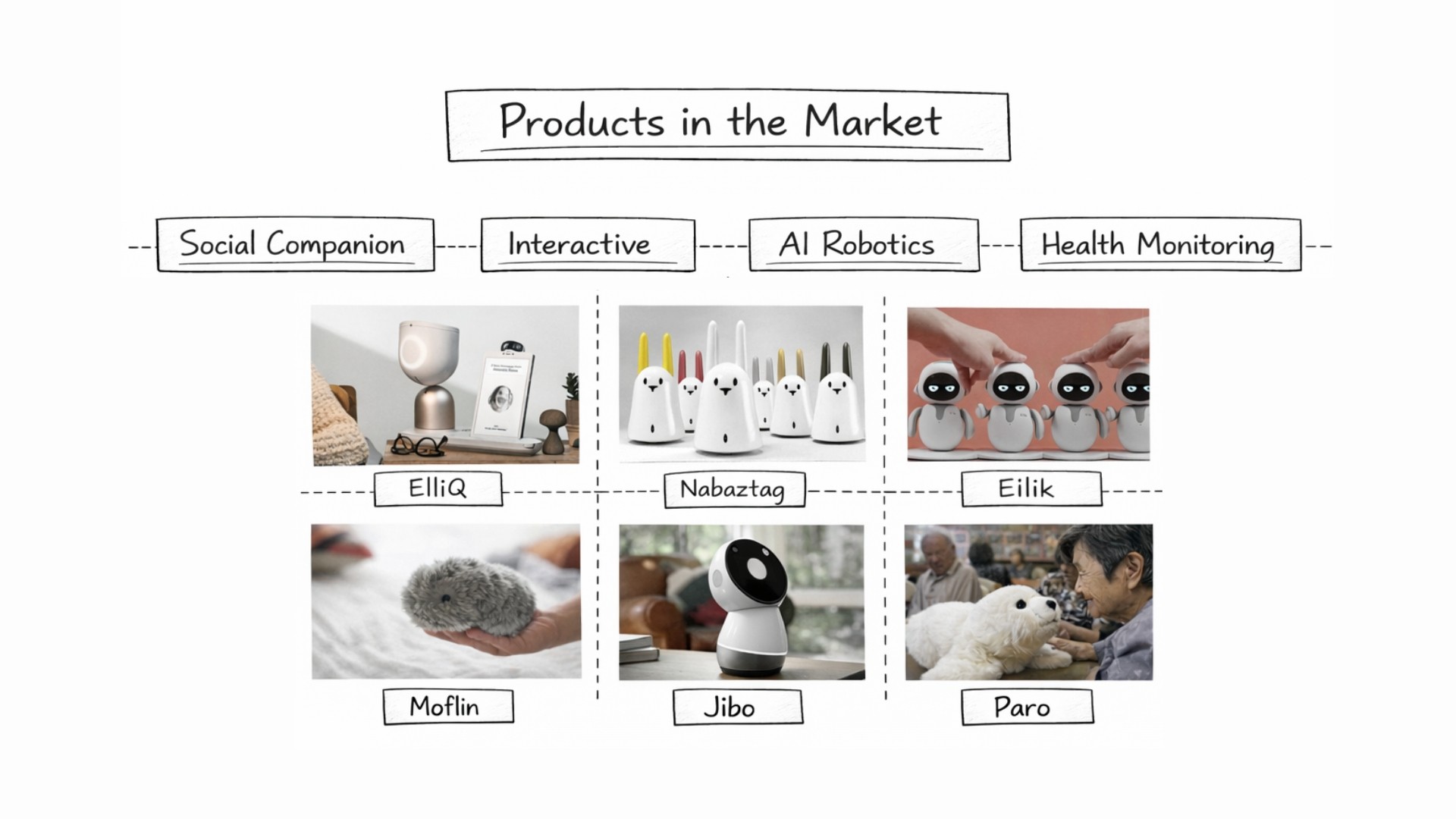
It remains a thoughtful student project supported by genuine research. At the same time, it exists within a crowded category of companion technologies. Products such as ElliQ, Jibo, Paro, and Moflin have already explored similar territory, often with strong execution and thoughtful design.
What stands out now is not the device itself, but the gap between what the research revealed and what the solution ultimately addressed.
The most important finding was never the absence of technology.
It was the breakdown of social connection touchpoints.
The challenge was not a missing device in the living room. It was the design of communication between older adults and the people around them. A companion robot cannot solve the fact that nobody initiates contact anymore.
That realization became increasingly important over time and ultimately influenced my interest in service design.
The intervention needed was not only a product. It was a systemic rethinking of how human connection is supported across age, distance, and everyday life.
A Personal Reflection
Looking back, there is an experience from 2019 that now feels unexpectedly connected to this project.
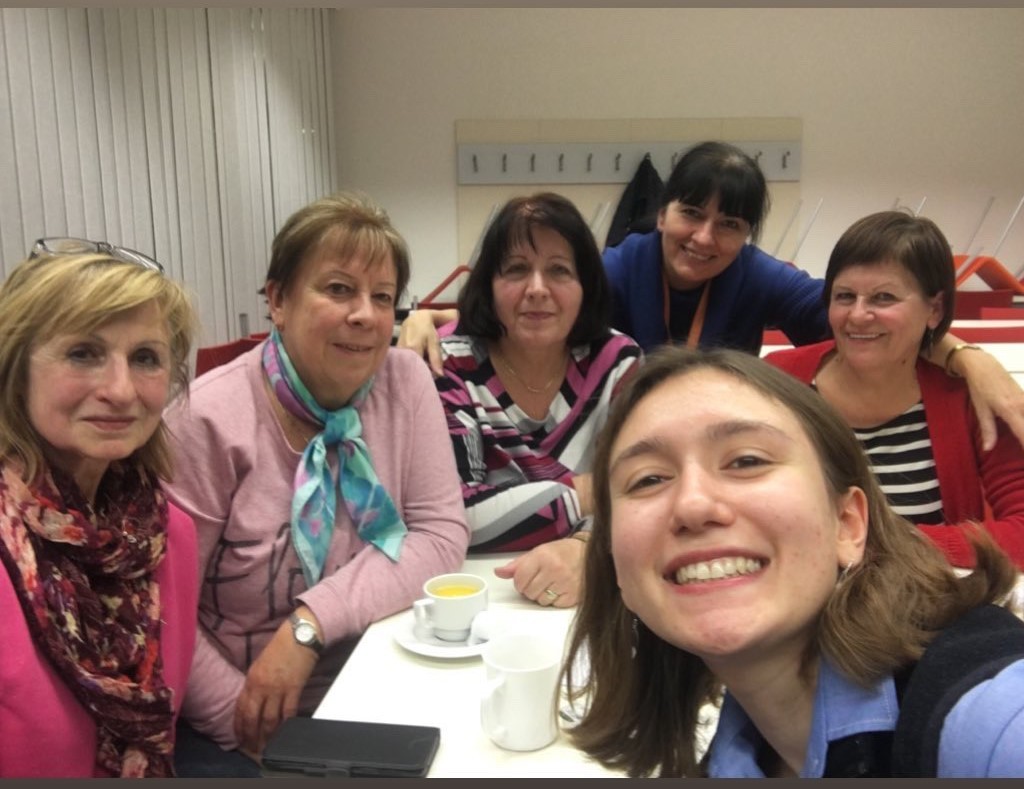
During my Erasmus exchange in the Czech Republic, a group of students was invited to practice English conversation with elderly women attending language classes. The women were curious, energetic, and eager to learn. Conversations moved from grandchildren and hobbies to dance classes, travel, and personal ambitions.
At the time, the experience felt enjoyable but unremarkable.
Years later, while researching ageing in Turkey, those conversations returned repeatedly.
The women were active, connected, and engaged, not despite their age but through the social structures surrounding them. Language classes, community activities, international exchange, and family relationships provided exactly the kind of connection that many research participants in Turkey described as missing.
The experience reinforced a simple but important idea:
The experience of ageing is shaped not only by individuals, but by culture, community design, and the expectations society places on older adults.
And that is not just an observation.
It is a design opportunity.
What This Project Represents
This project was my first experience discovering that the most interesting answer is not always the one written in the brief.
Sometimes research expands the problem rather than narrowing it.
Sometimes the solution becomes less important than the insight itself.
And sometimes the value lies not in the product that gets designed, but in the questions that continue long after the project ends.
If you're trying to understand what is really happening beneath the surface of human behavior, systems, and everyday experiences, this is the kind of research I enjoy doing.
DISCOVER MORE