Thesis: Emotional Sustainability in the Employee Experience
Most workplace wellbeing strategies treat emotions as a soft topic. This research argues they are central to the employee experience.

Project Overview
A master's thesis exploring the intersection of employee experience, emotional sustainability, and Emotion AI. The research investigated whether emerging technologies could support workplace wellbeing without compromising human dignity, autonomy, and trust.
Role: Independent Research, Literature Review, Expert Interviews, Research Synthesis
Context: Master's Thesis, Innovation Design Management
Focus: Employee experience, emotional wellbeing, Emotion AI, responsible technology, organizational systems
Outcome: Research findings and design considerations for integrating emotional awareness into workplace experiences responsibly.
About the Research
Work is where people spend a significant part of their lives. Yet the emotional reality of that experience often remains invisible within organizations.
How do people feel at work? What drains their energy, what motivates them, and what helps them feel valued? These questions are fundamental to employee wellbeing, but they are not always reflected in the systems organizations use to understand and improve the workplace.
At the same time, Emotion AI was emerging as a technology designed to detect, interpret, and respond to emotional signals through voice, facial expressions, physiological data, and behavioral patterns.
This raised an important question:
Can technology support workplace wellbeing without compromising human dignity, autonomy, and trust?

Rather than approaching the topic as a technology problem, I explored it as a systems problem. Employee experience is shaped by organizational culture, leadership, communication, individual needs, and the technologies used to support work. Understanding the relationship between these elements was essential to evaluating the potential role of Emotion AI.
Research Approach
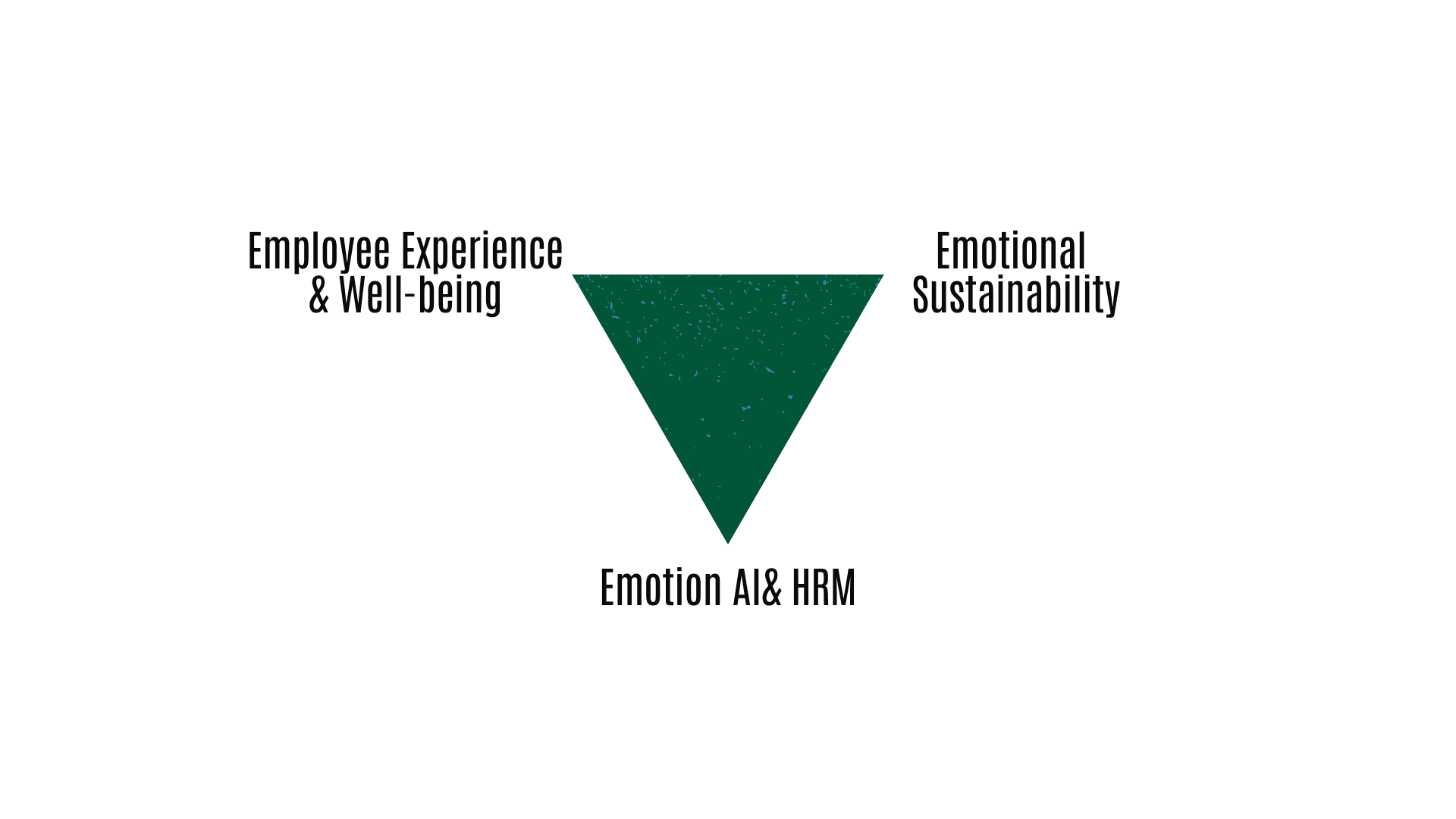
The topic was approached as a systems problem rather than a technology problem. Employee wellbeing sits at the intersection of multiple disciplines that rarely operate together:
Employee Experience
How people experience work and the factors that shape those experiences.Emotional Sustainability
The ability to maintain emotional wellbeing and resilience within organizational environments over time.Emotion AI
Technologies designed to detect, interpret, and respond to emotional signals through voice, facial expressions, physiological data, and behavioral patterns.
To complement the theoretical research, I interviewed two experts:
L. Holz, HR Specialist, who discussed the potential role of emotional feedback in workplace communication and cross-cultural understanding.
B. Demir Allan, Cognitive Scientist, who explored how emotional states may be reflected in voice patterns, physiological signals, and nonverbal behavior.
Bringing these perspectives together helped examine the topic beyond technical capability alone. The central question was not simply whether emotional signals could be detected, but how such information might be used, interpreted, and experienced within organizational systems.
Expert Perspectives
One recurring theme was the distinction between using Emotion AI to support communication and using it to monitor employees.
L. Holz highlighted the potential for emotional feedback systems to help people navigate cross-cultural communication. In this context, technology could act as a communication aid rather than a surveillance mechanism.
B. Demir Allan emphasized the importance of nonverbal feedback when understanding emotional states and workplace wellbeing. As she explained:
"Nonverbal feedback you get from people is usually the most accurate one."
These perspectives highlighted both the potential and the limitations of Emotion AI. Emotional signals may provide useful information, but interpreting them is complex, and their meaning depends on individual and contextual factors.
The research therefore shifted toward a broader question: under what conditions could emotional awareness support employees without reducing their experiences to data points?
Key Findings
Five things became clear through the research:

The question is no longer whether Emotion AI will be used. The real challenge is ensuring its implementation is transparent, ethical, and based on informed consent rather than invisible monitoring.

Many organizations continue to treat emotions as separate from performance. The research suggests the opposite. Emotional awareness contributes to creativity, engagement, commitment, and long-term wellbeing. Ignoring emotions does not remove them. It simply makes them harder to understand and address.

Burnout, anxiety, and disconnection rarely emerge in isolation. They are often symptoms of larger organizational systems, communication structures, leadership practices, and workplace cultures. Technology alone cannot solve structural problems.

Employees are not productivity metrics. Organizations that prioritize employee experience create stronger trust, deeper engagement, and more sustainable relationships between people and work.

Emotion AI introduces new forms of highly sensitive data, including emotional signals derived from voice, facial expressions, and physiological responses. While GDPR provides important protections for personal data, emotional data remains a largely undefined area, creating significant ethical and legal questions for organizations.
From Research to Design Considerations
The findings suggested that the potential value of Emotion AI depends less on its ability to detect emotional signals and more on the system surrounding its use.
If organizations decide to introduce these technologies, several questions should guide their decisions:
Transparency: Do employees understand what is being collected and how it is interpreted?
Consent and autonomy: Can employees make meaningful choices about participation and data use?
Purpose: Is emotional information being used to support employees, or primarily to monitor and evaluate them?
Context: Are emotional signals interpreted with an understanding of individual differences and workplace circumstances?
Organizational responsibility: Are the underlying causes of workplace distress being addressed, or is technology being used as a substitute for organizational change?
These considerations shift the conversation from what Emotion AI can technically do to what it should responsibly do.
They also highlight a wider opportunity for design: creating workplace experiences and organizational systems that support emotional wellbeing while protecting the people they are intended to serve.
What I Believe
The most complex human problems are rarely solved by adding more technology. They are solved by understanding people more deeply first, and then designing systems, services, and tools around those insights with care and responsibility.
The most important outcome of this research was not a conclusion about AI. It was a conclusion about people.
Emotion AI may offer opportunities to support communication and workplace wellbeing, but its use requires careful consideration of dignity, autonomy, trust, and the organizational conditions in which it operates.
The questions that matter most are human-centered:
What data is being collected?
Why is it being collected?
Who benefits from it?
Does the individual have a meaningful choice?
These are not only technology questions.
They are design questions.
Reflection
This research reinforced my belief that employee experience cannot be improved by focusing exclusively on tools, metrics, or individual behavior.
People experience work as part of a wider system. Their wellbeing is shaped by relationships, organizational structures, leadership, culture, and the degree of control they have over their own experiences.
Understanding these relationships requires looking beyond the immediate problem and questioning the assumptions behind proposed solutions.

For me, this is where research becomes particularly valuable: it creates space to examine complexity, connect perspectives from different disciplines, and identify opportunities that may otherwise remain overlooked.
That belief continues to shape how I approach service design, research, and strategy today.

