Night Trains: The Unseen Opportunity
Most people think night trains died because nobody wanted them. The research told a different story.

About the project
Night trains have long felt like an underestimated opportunity.
For travelers who cannot afford flights and accommodation separately, a night train solves two problems at once. The journey becomes the accommodation. Board in the evening, sleep overnight, and arrive in a new city the next morning.
Despite these advantages, many night train routes across Europe had disappeared. The question was whether demand had truly vanished, or whether the experience itself had failed to evolve alongside changing traveler expectations.
This project explored that gap.
Process
The challenge was blending wanderlust-driven storytelling with a functional, reliable travel platform. Peni needed to inspire emotion while ensuring users trusted them to plan their journeys.
The Brief
This collaborative research project investigated how night trains could be reintroduced and repositioned as a sustainable, affordable, and appealing alternative to short-haul European flights. Routes connecting cities such as Berlin, Paris, Zurich, and Amsterdam had been discontinued due to operational costs, regulatory complexity, and declining popularity.
At the same time, air travel remained one of the most carbon-intensive forms of transportation. One kilometer traveled by plane produces significantly more CO₂ emissions than the equivalent train journey.
The opportunity was clear. The challenge was understanding how night trains could compete not only environmentally, but experientially. My role within the project focused on UX research.
Research Questions
The research was guided by four key questions:
What would make travelers choose a night train over a flight?
How can affordability be balanced with comfort and experience?
Which traveler segments are most likely to adopt night trains?
How can sustainability be positioned as a benefit without sacrificing convenience?
Research Approach
A combination of qualitative and secondary research methods was used to understand both traveler expectations and market opportunities.
Benchmark Analysis
European night train services were compared with successful international examples, including Japan's Sunrise Express and Russia's Red Arrow. These services demonstrated how night trains could be positioned as desirable travel experiences rather than budget compromises.
User Segmentation
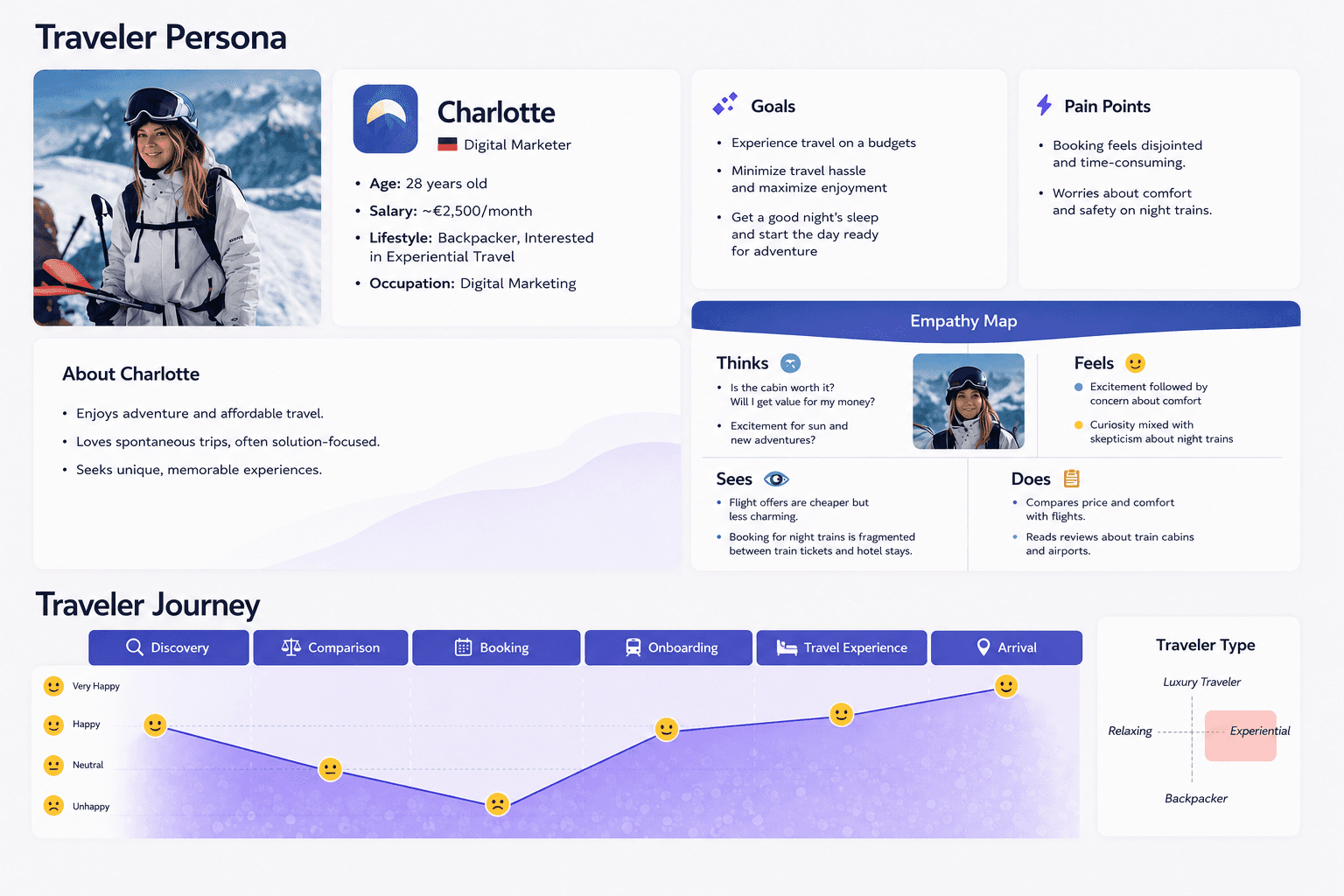
Traveler groups were mapped according to motivations, needs, and barriers.
Three key segments emerged:
Experience-seeking tourists who viewed travel as part of the adventure
Budget-conscious travelers focused on value
Eco-conscious professionals seeking lower-impact alternatives
Secondary Research
EU transport reports, sustainability studies, and travel trend data were reviewed to understand the historical decline of night trains and the conditions required for their revival.
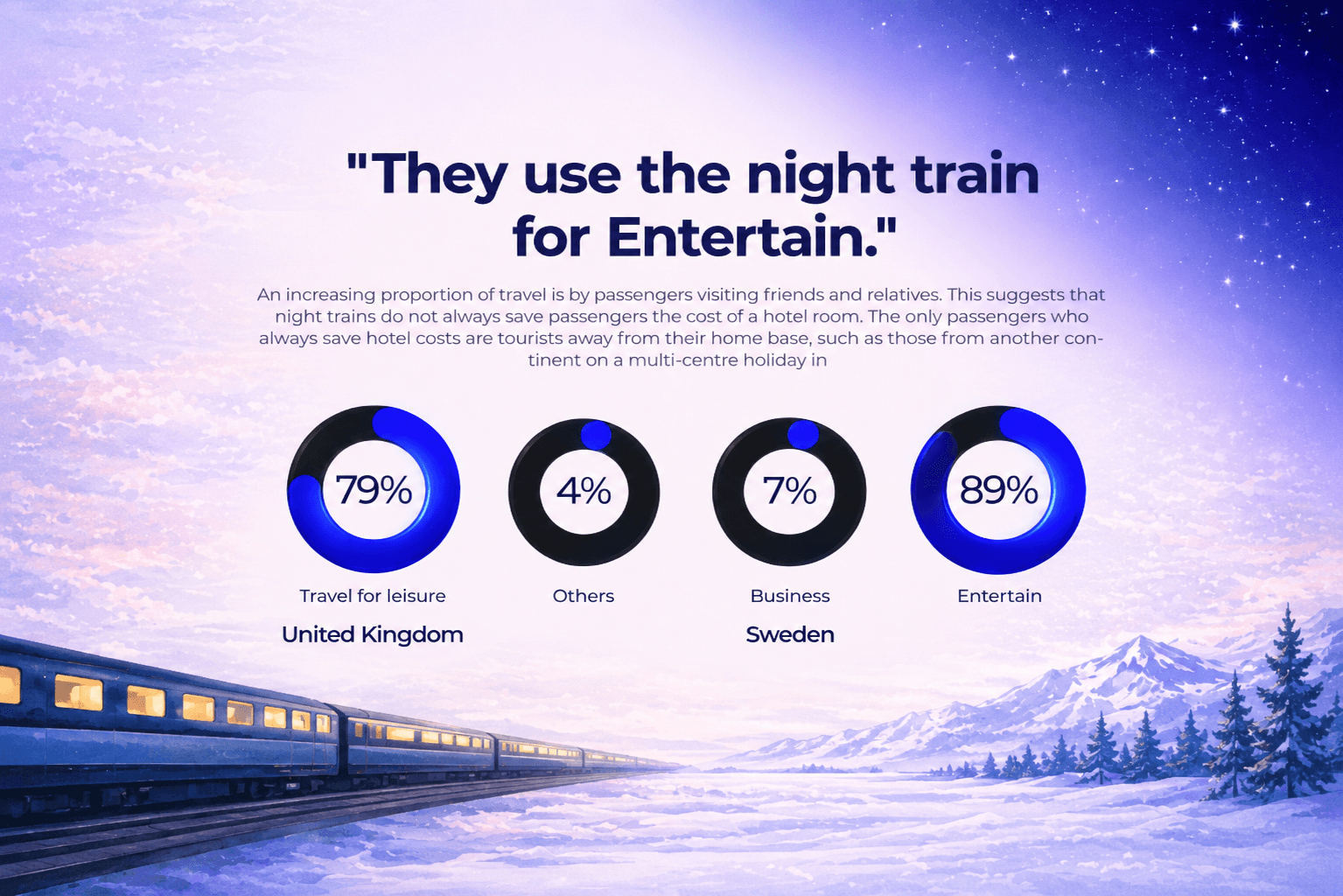
Competitive Landscape Analysis
Night trains were evaluated against budget airlines, long-distance buses, and high-speed rail services to identify realistic competitive advantages and limitations.
What the research revealed
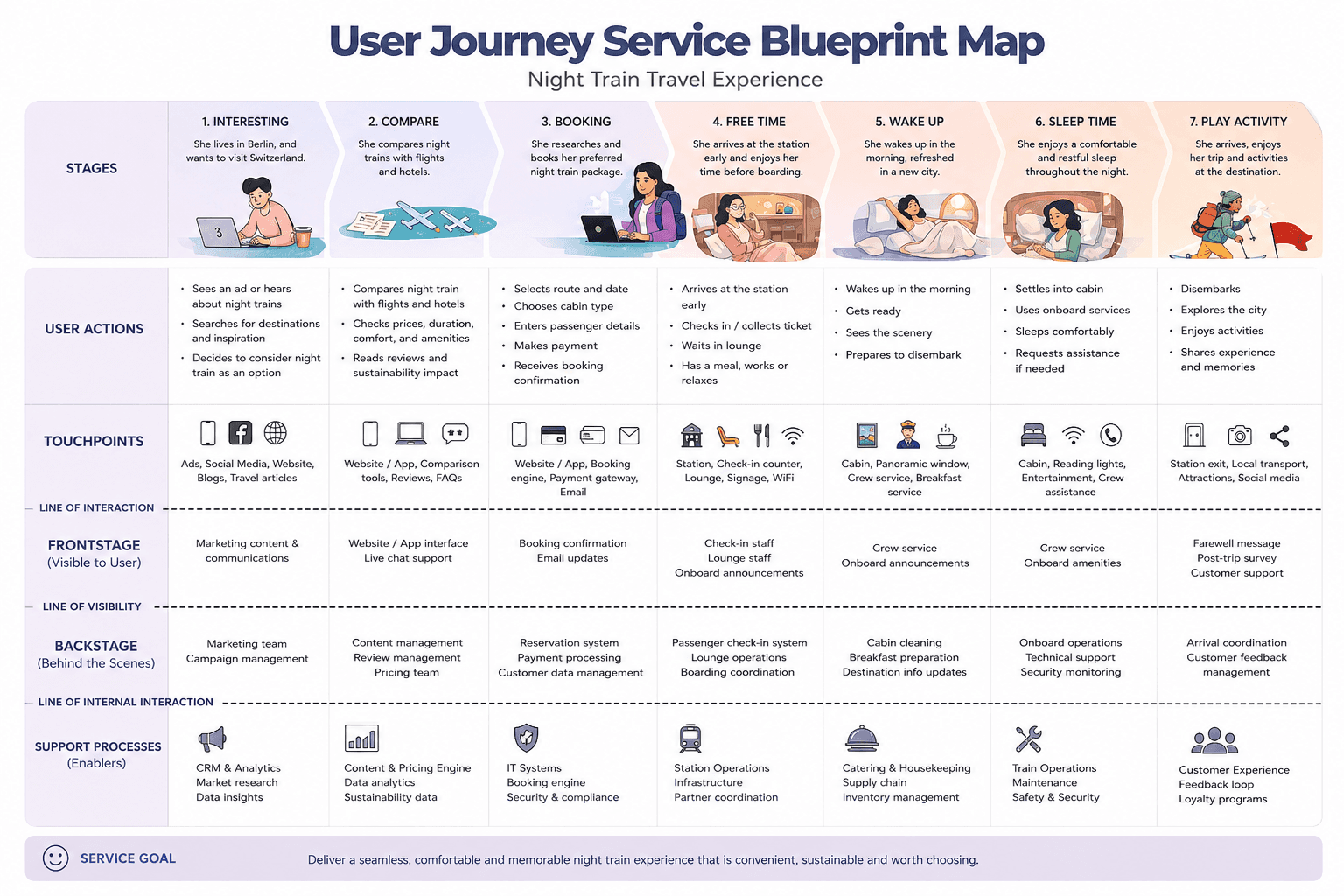
Travel can be part of the destination
The strongest differentiator was not sustainability. It was the experience itself. Falling asleep in one city and waking up in another creates a sense of adventure that flights cannot replicate. When designed intentionally, the journey becomes part of the value proposition.
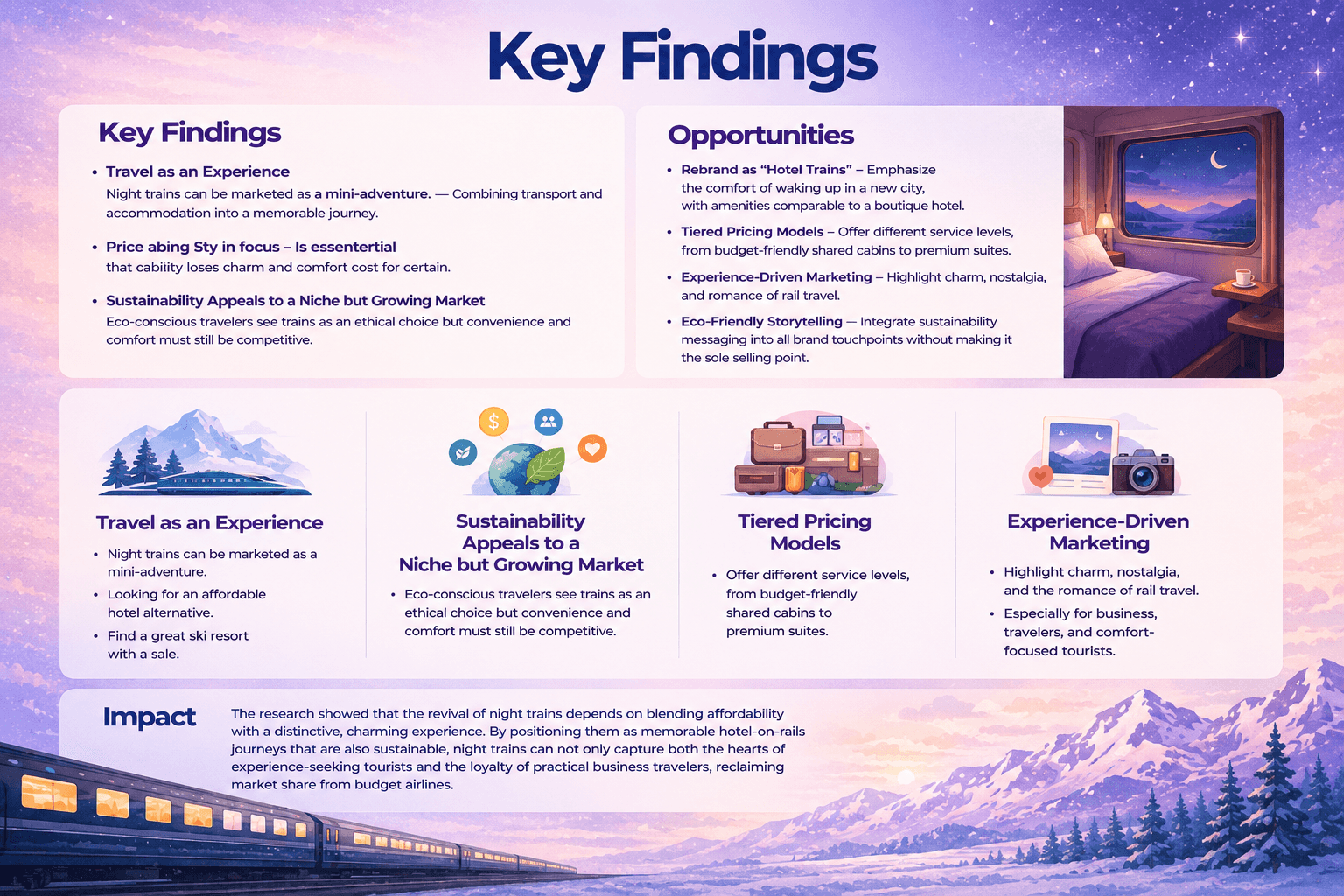
Affordability remains essential
Price remains one of the strongest drivers of adoption. For many travelers, night trains must remain competitive with low-cost airlines. However, research also suggested that some segments were willing to pay more for additional comfort, privacy, and convenience. The opportunity lies in offering meaningful choices rather than a one-size-fits-all experience.
Sustainability alone does not change behavior
Many travelers expressed positive attitudes toward sustainable transportation. However, environmental benefits rarely outweighed concerns around comfort, convenience, or cost. Sustainability worked best as an additional benefit rather than the primary selling point.
Amenities shape perceived value
Features such as private cabins, quality bedding, onboard dining, and reliable Wi-Fi significantly increased perceived value. For business travelers and comfort-focused tourists in particular, these elements transformed night trains from a compromise into an attractive alternative.
Reflection
Sometimes the opportunity is not hidden in what a service does. It is hidden in how people experience it.
The most valuable insight from this project was that people rarely choose services based on functionality alone.
The night train already solved a transportation problem.
What it failed to communicate was the experience surrounding that solution.
The research revealed that adoption depends on more than infrastructure. It depends on how people perceive value, comfort, identity, and emotion throughout the journey.
That lesson continues to influence how I approach research today.
DISCOVER MORE


